


It happens at almost every family dinner, office party, or barbecue the moment someone notices you are passing on the meat. First comes the question about where you get your protein. Then, often delivered with a triumphant smirk, comes the ultimate "gotcha" question:
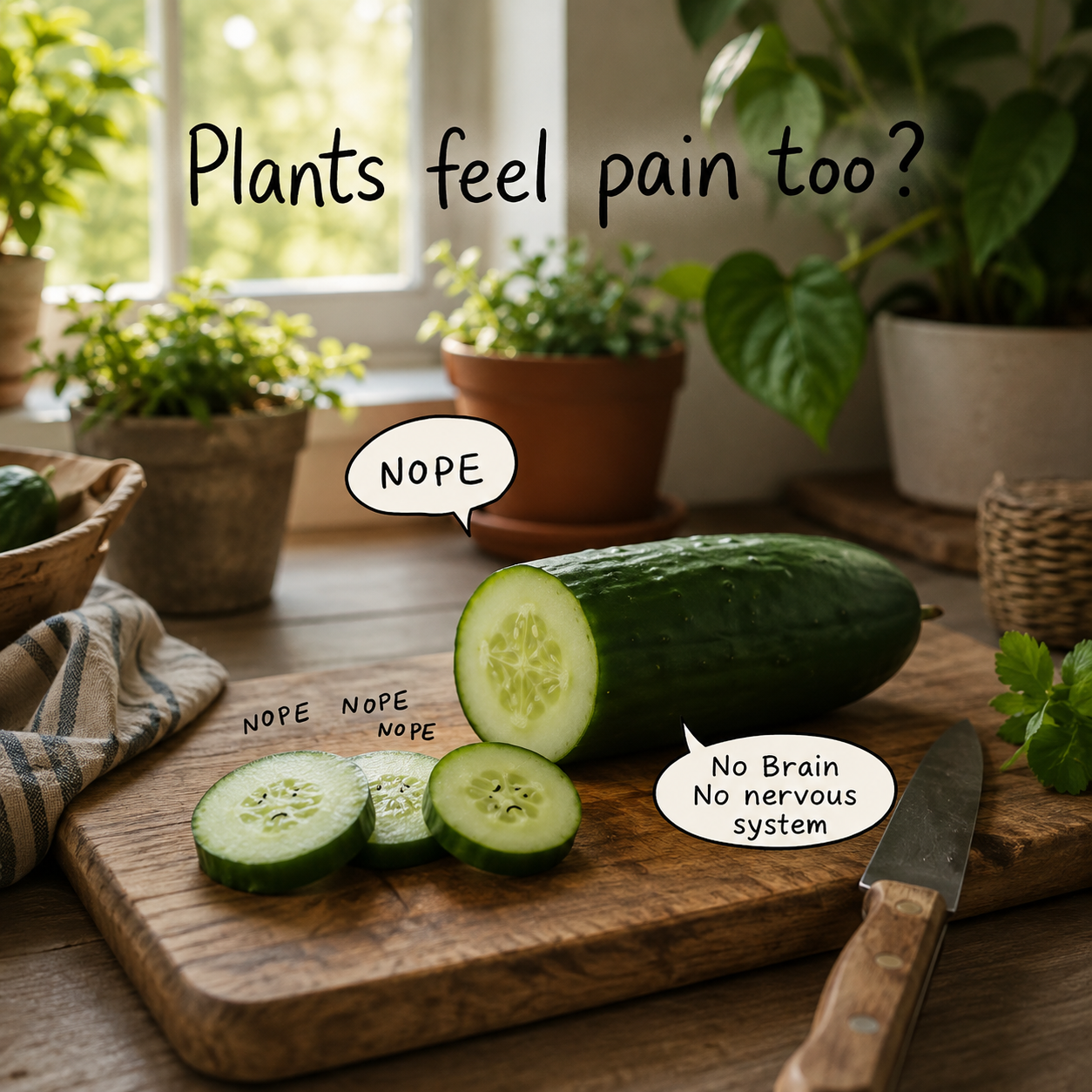
But what about the plants? Plants feel pain too, you know! How is eating a salad any different?
It is a favourite defence mechanism for critics of plant-based diets. And while it is easy to brush it off with an eye-roll, it is actually a fantastic opportunity to have a real conversation. Does a carrot suffer when it is pulled from the soil? Does a blade of grass scream when it meets the lawnmower?
1. The Biology of Suffering: Where is the Hardware?
To experience pain as we understand it that conscious, agonizing feeling that makes you instantly pull your hand away from a hot stove an organism needs a very specific set of biological tools.
Mainly, it needs a central nervous system (CNS) and a brain.
Pain is not just physical damage; it is a subjective experience. Sensory receptors (called nociceptors) detect damage and send a lightning-fast electrical signal through a nervous system to a brain. The brain then translates that raw data into the conscious experience of suffering.
Plants have none of this hardware. They possess no brain, no central nervous system, and no pain receptors. A potato does not have the biological equipment required to feel pain any more than your smartphone does when you drop it and crack the screen.
2. The "Wood Wide Web": Communication is Not Consciousness
Here is where the science gets fascinating, and where the "plants feel pain" argument finds its tiny, misunderstood grain of truth. Plants do react to their environment in incredibly complex ways.
Have you ever smelled the sweet, nostalgic scent of freshly cut grass? That smell is actually the plant releasing Green Leaf Volatiles (GLVs) a chemical distress signal. Below ground, trees can share nutrients and send chemical warnings to one another through vast fungal networks known as the "Wood Wide Web." When attacked by aphids, some plants release specific chemicals into the air to attract the exact species of wasp that preys on those aphids.
This is brilliant, breathtaking biology. But reaction is not the same as consciousness.
- Your smartphone reacts to a low battery by dimming the screen.
- Your body automatically reacts to an infection by raising its core temperature.
- A Venus flytrap snaps shut when its trigger hairs are touched.
These are automated, evolutionary responses. An organism can be biologically alive and highly responsive without possessing the subjective, conscious awareness required to suffer. Plants are masters of chemical engineering, but there is no "someone" inside the plant experiencing the world.
3. The Evolutionary Flaw: Why Evolve Pain if You Cannot Run?
Here is a lesser-known point that completely dismantles the idea of plant suffering: Evolution is ruthlessly efficient.
Why did pain evolve in the animal kingdom in the first place? It serves a very specific, life-saving purpose: Fight or Flight. Pain is an evolutionary alarm bell that screams, "You are in danger, move away immediately!"
If you step on a sharp rock, pain forces you to lift your foot. If a gazelle is bitten by a predator, pain triggers a massive surge of adrenaline, allowing it to sprint away.
Furthermore, brains and nervous systems are incredibly "expensive" to maintain. The human brain makes up only 2% of our body weight but burns roughly 20% of our daily calories.
Now, imagine a plant expending massive amounts of energy to evolve a brain and the capacity to feel excruciating conscious pain, only to be completely rooted to the ground. If a tree catches fire or a bush is being eaten by a deer, it cannot run away. It cannot fight back. Evolving a conscious experience of agony without the physical mobility to escape it would be an evolutionary dead end.
4. The Line Between "Alive" and "Sentient"
Sometimes, the argument shifts to, "Well, plants are alive, and vegans are still killing living things."
This is entirely true. Vegans consume living things. But the ethical distinction is not based on whether something is biologically alive (bacteria, fungi, and plants are all alive). The distinction is based on sentience the capacity to feel, perceive, and experience subjective suffering.
Swatting a mosquito, cutting a head of lettuce, and slaughtering a pig all end biological life. But only one of those actions inflicts terror and pain on a highly sentient, emotionally complex creature that desperately wants to live. Drawing a moral equivalence between harvesting wheat and killing an animal ignores everything we know about biology and psychology.
5. The Trump Card: The "Plant Rights" Paradox
Let us play devil's advocate. For a moment, let us pretend the impossible is true and plants do possess a hidden consciousness and feel agony when harvested. Let us say every stalk of corn weeps.
If a critic truly believes this and wants to minimize plant suffering, the most logical step they could take is still to go vegan.
Why? Because of how the food chain works. The animals raised for meat do not grow on air. A cow, pig, or chicken must consume massive amounts of crops over months or years before it is eventually slaughtered.
- It takes roughly 10 to 16 pounds of plant matter (like soy, corn, and oats) to produce just 1 pound of beef.
- Over 70% of all the soy grown globally is fed directly to livestock, not humans.
When you choose to eat an animal, you are not just responsible for the death of that animal. You are also indirectly responsible for the "deaths" of the thousands of plants that animal had to consume during its lifetime. Eating plants directly cuts out the middleman, meaning the vegan saves astronomically more plants than the meat-eater.
6. The Other Classic Deflection: "But We Have Canine Teeth!"
Often, when the "plants feel pain" argument runs out of steam, the conversation pivots to our own anatomy. Someone will point to their mouth and say, "If we aren't supposed to eat meat, why do we have these canine teeth? We are apex predators!"
It sounds logical until you actually look at the anatomy of our mouths and the rest of the animal kingdom.
Our Canines Are Pathetic
Run your tongue over your canine teeth. They are short, blunt, and barely longer than your incisors. If a human tried to leap onto the back of a wild antelope and bring it down using only their teeth, the result would be a trip to the dentist. Compare that to a lion or a bear, whose canines are long, curved, serrated daggers designed to pierce hide and tear raw muscle. Our teeth are built for getting a solid grip on a firm, round piece of fruit like a crisp apple.
The Heavyweights of the Plant World
Having canine teeth does not mean an animal eats meat. The hippopotamus is entirely herbivorous, yet its canines can grow up to a foot and a half long. Silverback gorillas, who share roughly 98% of our DNA, possess massive, razor-sharp fangs but thrive on a diet that is almost entirely leaves, shoots, and fruit. In the animal kingdom, large canine teeth evolved for defense, mating displays, or cracking open hard nuts not just for eating meat.
Look at the Whole Machine
Singling out two small canine teeth while ignoring the other 30 teeth in a human mouth is like looking at a car's steering wheel and concluding it must be a boat. When we compare human mouths to true meat-eaters, the differences are striking:
True carnivores slice off a chunk of meat and swallow it whole. Humans have jaws designed to move laterally to grind up fibrous plant material between flat molars, just like horses, cows, and primates.
The Long and Winding Road
Meat is highly perishable. True carnivores have short, smooth, highly acidic digestive tracts (3 to 6 times their body length) to process raw flesh before it putrefies. Humans have winding, bumpy intestines that are roughly 10 to 12 times our body length. This is a classic herbivore trait, required for the slow fermentation process needed to break down complex plant carbohydrates.
We eat meat because early hominids invented tools to hunt and fire to cook softening meat and killing bacteria our weak stomach acids cannot handle. We eat it because of technology, not biology.
Arguments like "plants feel pain" and "we have canine teeth" are rarely brought up out of a genuine concern for broccoli or a deep passion for evolutionary biology. They are psychological defence mechanisms ways to deflect the uncomfortable reality of animal agriculture and alleviate cognitive dissonance.
Animals scream, they fight for their lives, and they possess the exact same nervous system architecture that causes us to suffer. We know beyond a shadow of a doubt that they feel pain. Conversely, our flat molars and long intestines heavily point to a natural diet rooted in fruits, vegetables, seeds, and nuts.
So, the next time someone brings up the feelings of a carrot or flashes their "fangs" in defence of a steak, you do not need to argue aggressively. You can just smile and share the good news: science, evolution, and basic anatomy all confirm that choosing a plant-based meal is a win for the animals, a massive win for the planet, and perfectly fine for the plants.
AUTHOR: - RAVINANDAN BAJPAI
B.B.A. LL. B(HONS.),
School of Law, University of Mumbai

































Leave a Reply
Let us know what you think about the blog post above, we’re interested in hearing from you!